
https://www.ctxkh.com/a-comprehensive-guide-to-chinas-regional-culinary-traditions/
While Londoners were still debating whether scones should be topped with cream or jam, Grandma from Guangzhou had already deconstructed the morning social code with a pot of chrysanthemum tea – the tea houses in this city consume 23 tons of shrimp dumplings every day, and the family secrets spun on the table have 200 more flavor levels than English afternoon tea.
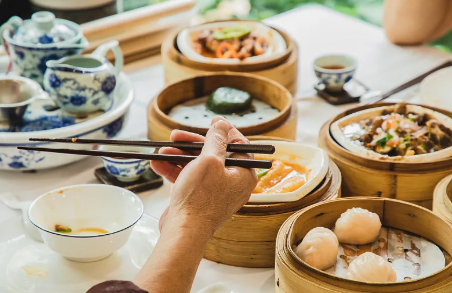
Decoding Morning Tea Code: From Cart Wars to Tea Cup Knocking
1. Tea lid tilted at 15 °=SOS signal
Lifting the lid and leaning against the rim of the cup is the Morse code for “water continuation”, and the accuracy of this action determines the classification of the stroller auntie for you: tourist (ignore) vs. foodie (with a hidden menu included). In a teahouse, the tilt angle of the tea lid is not only a signal for refilling water, but also a tacit communication between the waiter and the tea house. Regular customers convey their needs to the waiter through this subtle gesture, while the waiter quickly judges the customer’s level of experience by observing the angle of the tea lid and provides corresponding services.
2. Fingertips on the table: The Thanksgiving tea ceremony during the colonial era
Legend has it that during the reign of Emperor Qianlong, when he served tea to his courtiers, they would kneel and kowtow with their bowing fingers. Now, lightly tapping the table with three fingers is a “miniature bow” to the tea master. This tea ceremony has evolved into a simple and elegant etiquette in Cantonese morning tea, which not only reflects respect for tea masters, but also demonstrates the inheritance and respect of traditional culture by Guangzhou people.
3. Mysterious totemism on Dim sum card
The waiter uses a red and blue seal to draw symbols on the card: △=Order placed, ○=Urgent, ▽=Cancel. Mastering this symbol system enhances combat effectiveness beyond the Michelin reservation app. In the teahouse, the Dim sum card is not only a tool for recording guests’ orders, but also an efficient way of communication. Through these simple symbols, the waiter can quickly and accurately serve the guests and ensure that every Dim sum can be delivered to the guests in time.
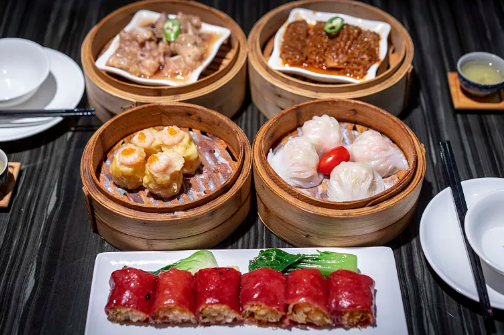
Dim sum Biology: Scientific Deconstruction of the Four Heavenly Kings
Shrimp Dumplings: Fluid Dynamics of 13 pleats
Wrap 3 intact sea shrimps in bamboo dough, with wrinkles greater than 12 and less than 15- this is the golden balance between steam penetration and filling freshness. The production process of shrimp dumplings is very particular, from the making of the dough to the selection of the filling, every step affects the taste and flavor of the shrimp dumplings. The folds of shrimp dumplings are not only beautiful, but also affect the penetration speed of steam, ensuring the deliciousness and tenderness of the filling.
Cha siu bao: Crack is justice
The “flowering” crack produced by fermentation should have three petals, and the saccharification temperature at the crack must be controlled at 230 ° C, mimicking the original aroma of lychee charcoal burning. The crack of Cha siu bao is one of its characteristics. It not only increases the beauty of Cha siu bao, but also makes Cha siu bao smell better during baking. The formation of cracks is closely related to the temperature of fermentation and baking, and requires precise control.
Intestine powder: 0.5mm second speed revolution
For every 0.1mm reduction in the thickness of sausage powder, the penetration rate of soy sauce increases by 47%. Time honored brands use Thai fragrant rice and Wuzhou well water to achieve millimeter level silky smoothness. The thickness of intestine powder directly affects its taste and flavor. Thin and transparent intestine powder can better absorb the taste of soy sauce during steaming, thereby enhancing its flavor. Time honored brands use high-quality ingredients and unique production techniques to control the thickness of intestine powder at the millimeter level, creating the ultimate taste.
Egg Tart: The Sweet Uprising of 1927
When Portuguese egg tarts were still using cinnamon powder, Guangzhou chefs had already invented the molecular cooking prototype of “cookie skin+ginger sauce stewed with milk filling”. Guangzhou style egg tarts have innovated on the basis of traditional Portuguese egg tarts, using cookie skins and ginger stewed milk filling. This unique combination not only retains the sweetness of the egg tarts, but also adds the spiciness of the ginger juice, making it more in line with the taste of Guangzhou people.
conclusion
Cantonese morning tea is not only a culinary culture, but also an art of life. It integrates food, etiquette, and culture, showcasing the love and pursuit of Guangzhou people for life. By understanding the secret language of Cantonese morning tea and the production process of Dim sum, we can not only enjoy this food better, but also feel the profound cultural heritage of Guangzhou. I hope this blog can give you a deeper understanding of Cantonese morning tea, and I also look forward to you personally tasting this delicious dish in the near future, embarking on a taste journey of your own in the world of Cantonese morning tea.
https://www.ctxkh.com/a-comprehensive-guide-to-chinas-regional-culinary-traditions/